Several Malaysian states have landed among the top-paying regions in ASEAN for average monthly salaries in 2025, according to an infographic by ASEAN Skyline, placing Malaysia prominently on the regional map.
Top 10 ASEAN regions by average monthly salary (2025)
- Singapore — USD 4,457 (RM17,380)
- Kuala Lumpur (MY) — USD 1,321 (RM5,150)
- Putrajaya (MY) — USD 1,260 (RM4,910)
- Selangor (MY) — USD 1,085 (RM4,230)
- Labuan (MY) — USD 1,040 (RM4,060)
- Penang (MY) — USD 965 (RM3,760)
- Johor (MY) — USD 915 (RM3,570)
- Bangkok (TH) — USD 841 (RM3,280)
- Nonthaburi (TH) — USD 807 (RM3,150)
- Phuket (TH) — USD 786 (RM3,070)
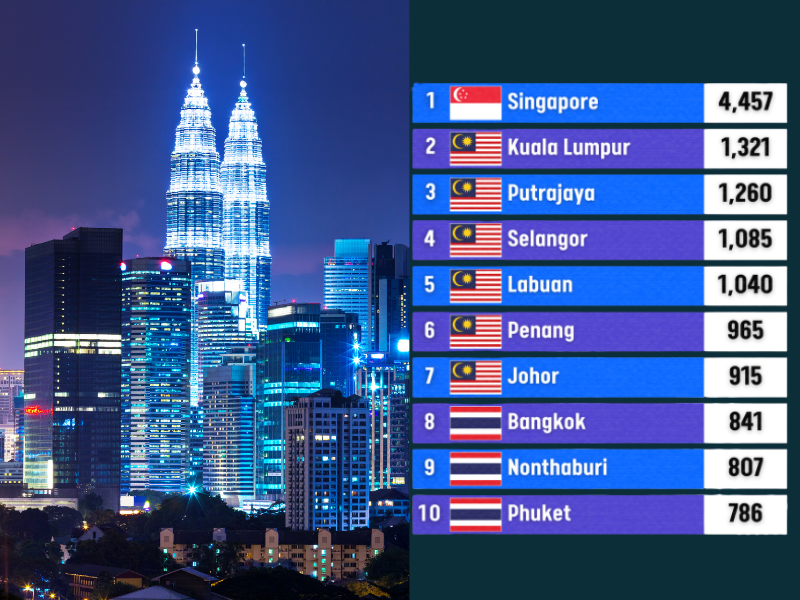
Image credits: Canva, ASEAN Skyline (Facebook)
Malaysia’s presence is especially strong in the top tier, with six regions securing spots in the top 10. Kuala Lumpur ranked second overall, trailing only Singapore, while Putrajaya, Selangor, Labuan, Penang and Johor all placed ahead of several major cities in neighbouring countries.
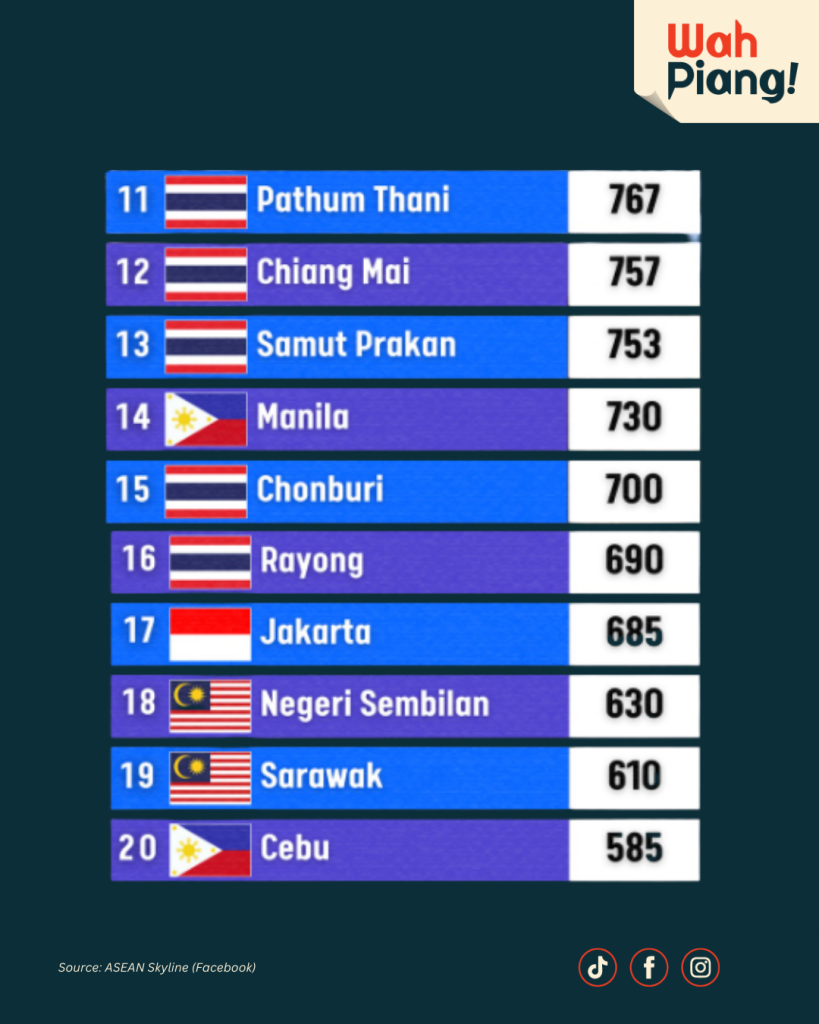
Other ASEAN regions ranked 11–20:
- Pathum Thani (TH) — USD 767 (RM2,990)
- Chiang Mai (TH) — USD 757 (RM2,950)
- Samut Prakan (TH) — USD 753 (RM2,940)
- Manila (PH) — USD 730 (RM2,850)
- Chonburi (TH) — USD 700 (RM2,730)
- Rayong (TH) — USD 690 (RM2,690)
- Jakarta (ID) — USD 685 (RM2,670)
- Negeri Sembilan (MY) — USD 630 (RM2,460)
- Sarawak (MY) — USD 610 (RM2,380)
- Cebu (PH) — USD 585 (RM2,280)
Beyond the top 10, Malaysia continued to feature on the list through Negeri Sembilan and Sarawak, underscoring the country’s broad representation across the region’s higher-paying areas.
The rankings were compiled using data from national statistical agencies across ASEAN, including Malaysia’s Department of Statistics, Thailand’s National Statistical Office, Indonesia’s Badan Pusat Statistik, and the Philippine Statistics Authority.
While some netizens welcomed the rankings as a sign of Malaysia’s economic competitiveness, others questioned whether average salary figures truly reflect everyday realities.
Many pointed out that rising living costs, particularly housing, rent, food and transportation continues to place financial pressure on residents in major cities. Others argued that average figures may not fully represent lower-income earners, potentially masking widening income disparities.
On paper, the rankings appear encouraging. In reality, the conversation around cost of living and purchasing power remains far from settled.
Follow Wah Piang for more.